Renton1875 

Recovering Beta


Posts: 217
Joined: Sep 2013
Reputation: 3
|
RE: All of recorded history is wrong!
We have a few anomalies in our historic past.
On the subject of voyages to the Americas.
How about the Sinclair (St Clair) family.
Rumoured strong connections with the Knights Templar.
Builders of the Mysterious and now ( after 'The Da Vinci Code' ) World famous Rosslyn Chapel, built in 1446 by the Grandson of Henry I Sinclair, Earl of Orkney.
http://www.rosslynchapel.com/
Folklore has it that Henry I Sinclair, Earl of Orkney, sailed to the Americas 100 years before Christopher Columbus.
Although this is disputed by 'official historians' it does have a growing band of believers.
The background story:
http://www.undiscoveredscotland.co.uk/us...clair.html
Quote:The story so far is relatively uncontroversial. Take a deep breath, because from here on it is anything but... While in Shetland, Sinclair is believed to have rescued two Venetian brothers, Nicolo & Antonio Zeno, whose ship had run aground and who were under threat from the islanders. In return the brothers undertook to put their undoubted seafaring skills at Sinclair's disposal.
Meantime, a fisherman turned up in Orkney who had been missing for twenty years. He told a remarkable story of having been driven far west by storms and reaching a temperate land peopled by strange natives. Greenland was already known and, indeed, had been claimed by Norway since 1261, and the fisherman's stories suggested that there was somewhere beyond. Sinclair was determined to find out what lay behind these stories, and some time in the late 1390s led an expedition west, accompanied by the Zeno brothers.
Passing beyond Greenland, they landed in what could well be Newfoundland, before pressing on to "a fertile land, mild and pleasant beyond description". Sinclair returned to Orkney in 1399, telling stories of the land he had found and making plans to return on a more organised scale. It was not to be: he died fighting English raiders in Orkney in 1400.
It would be fair to say that this story is far from universally accepted. The main documentary evidence comes from letters supposedly written between the Zeno brothers in around 1400, which some regard as forgeries from the 1500s. Even if the letters are genuine, the story hangs on the man they refer to throughout as Zichmni being Henry Sinclair. There are also geographic problems with the letters: they refer to islands off the east coast of Iceland that do not exist, and there are other discrepancies.
On the other hand, the Micmac tribe of Nova Scotia tell a traditional story about a king who had three daughters who travelled from an island far across the sea with many soldiers, stayed for a year and left again: a story that fits exactly with the Zeno brothers' account of events. There is also, at Westford in Massachusetts, a rock with a strange design on it. In the right light, this can look like the outline of an armoured knight, complete with a shield bearing the crest of the Clann Gunn. This is claimed to be the memorial to Sir James Gunn, presumably lost on the expedition during an effort to explore the interior of the New World. The modern stone nearby reads: "Prince Henry First Sinclair of Orkney Born in Scotland made a voyage of discovery to North America in 1398. After wintering in Nova Scotia, he sailed to Massachusetts and on an inland expedition in 1399 to Prospect Hill to view the surrounding countryside, one of the party died. The punch-hole armorial effigy, which adorns this ledge is a memorial to this knight."
Supporters of this theory point also to the presence of Newport Tower in Rhode Island, a stone structure of indeterminate but clearly pretty considerable age. They also note that in 1849 a cannon of Venetian design allegedly dating back to the late 1300s was dredged from the harbour of Louisberg on Cape Breton Island: exactly the sort of cannon that would have been carried on their ship by the Zeno brothers and salvaged by Sinclair from the wreck as highly valuable.
Non-believers will tell you that the "Westport Knight" is an image formed largely from natural weathering of the rock, with some superimposed carving from the 1800s; and that the Newport Tower was originally a mill dating back to the 1600s.
Part of the continuing mystery finds a home - perhaps inevitably - in Rosslyn Chapel. Built by Sinclair's grandson, this includes carvings of what look very like Indian corn or maize, and cactus plants, both supposedly unknown at the time. How could these images appear in the Rosslyn Chapel if Henry Sinclair had not made his voyage to the New World? As ever, proving a negative is impossible, and in the absence of truly conclusive positive proof, it is up to each of us to make up our own minds. It's a nice story, though...
From wiki:
https://en.m.wikipedia.org/wiki/Henry_I_..._of_Orkney
Quote: Fringe theories:
In the 1980s, modern alternative histories of Earl Henry I Sinclair and Rosslyn Chapel began to be published. Popular books (often derided as pseudo-history) such as The Holy Blood and the Holy Grail by Michael Baigent, Richard Leigh and Henry Lincoln (1982) and The Temple and the Lodge by Michael Baigent and Richard Leigh (1989) appeared. Books by Timothy Wallace-Murphy and Andrew Sinclair soon followed from the early 1990s onwards.
The alleged voyage to North America:
Monument to the alleged landing site of the Sinclair Expedition, Guysborough, Nova Scotia.
Almost nothing more[clarification needed] is known about Sinclair's life. However, much has been written through conjecture about his supposed career as an explorer. In 1784, he was identified by Johann Reinhold Forster[7] as possibly being the Prince Zichmni described in letters allegedly written around the year 1400 by the Zeno brothers of Venice, in which they describe a voyage throughout the North Atlantic under the command of Zichmni.[8]
The authenticity of the letters (which were allegedly rediscovered and published in the early 16th century), the exact course of the voyage, as well as whether it even took place, are challenged by historians. Most regard the letters (and the accompanying map) as a hoax by the Zenos or their publishers.[8] Moreover, the identification of Zichmni as Henry Sinclair has not been accepted by most historians, although it is taken for granted by the supporters of the theory.
Some supporters of the theory contend that there are stone carvings of American plants in Rosslyn Chapel in Scotland.[9][10] The Chapel was built by Henry Sinclair's grandson William Sinclair and was completed in 1486. Columbus made his first voyage in 1492. This is seen by writers Christopher Knight and Robert Lomas as being compelling evidence for the theory that Sinclair had sailed to America,[9] although scholars have said the plants are simply stylised depictions of common European plants.[11]
Also commonly cited is the Westford Knight, a rock carving in Westford, Massachusetts, that allegedly depicts one of Sinclair's companions, Sir James Gunn. Although one of the features, having the appearance of a sword handle, is definitely a carving of some sort, modern historical studies have identified the rest of the marks as naturally occurring glacial scratches. Moreover, the rock in question is not thought[by whom?] to have been accessible during the time of Sinclair's alleged journey.
In addition, some writers such as Native American historian Evan Pritchard have claimed that Glooscap, the spiritual hero figure of the Mi'kmaq people, is in fact a depiction of an early European explorer, most likely Henry Sinclair.[12][13]
The claim that Henry Sinclair explored North America has been popularised by several other authors, notably by Frederick J. Pohl,[14] Andrew Sinclair,[15] Michael Bradley,[16] William S. Crooker (who claimed to have discovered Henry Sinclair's castle in Nova Scotia),[17] Steven Sora,[18] and more recently by David Goudsward.[19] The claim is based on several separate propositions:
That the letters and map ascribed to the Zeno brothers and published in 1558 are authentic.
That the voyage described in the letters as taken by Zichmni around the year 1398 to Greenland actually reached North America.
That Zichmni is Henry Sinclair.
The name "Zichmni" is either totally fictitious, or quite possibly a transliteration error when converting from handwritten materials to type. Johann Reinhold Forster[7] tried to relate this to the name "Sinclair", but "Prince Sinclair" is not normal usage, while "Prince of Orkney" seems a better fit, and Frederick Pohl points out that the "Z" could have easily come from a misreading of the cursive "d'O" in "d'Orkney".[20] In addition, the "k" and "y" do not appear in Italian, so would need to be represented by other letters – "ch" in Italian is a hard "k" sound, so might well have been used to represent the "k".[14]
In his letters, Antonio Zeno describes a spring of pitch running down to the sea. In his book, Frederick Pohl states that this seems to support the idea that the voyage actually took place, as it can be related to the Stellarton region of Nova Scotia, famous for its oil shales. There are still place names today in the area referencing the word "Asphalt".[14]
The Prince Henry Sinclair Society of North America believe he landed at Chedabucto Bay, Nova Scotia in 1398. The monument to the expedition was erected on November 17, 1996. It is a fifteen-ton granite boulder with a black granite narrative plaque located at Halfway Cove on Rt. 16 in Guysborough County, Nova Scotia.
Alleged Templar connections
Intertwined with the Sinclair voyage story is the claim that Henry Sinclair was a Knight Templar and that the voyage either was sponsored by or conducted on the behalf of the Templars, though the order was suppressed almost half a century before Henry's lifetime.
Knight and Lomas speculate that the Knights Templar discovered under the Temple Mount in Jerusalem a royal archive dating from King Solomon's times that stated that Phoenicians from Tyre voyaged to a westerly continent following a star called "La Merika". According to Knight and Lomas, the Templars learned that to sail to that continent, they had to follow a star by the same name. Sinclair supposedly followed this route.[21]
The theory also makes use of the supposed Templar connection to explain the name Nova Scotia ("New Scotland" in Latin). It is based on the 18th-century tale that some Templars escaped the suppression of their order by fleeing to Scotland during the reign of Robert the Bruce[22] and fought in the Battle of Bannockburn.[23]
Claims persist that Rosslyn Chapel contains Templar imagery. Andrew Sinclair speculates that the grave slab now in the crypt is that of a Templar knight:[24] According to author Robert Lomas, the chapel also has an engraving depicting a knight templar holding the sword over a head of an initiate, supposedly to protect the secrets of the templars.[25] Rosslyn Chapel was built by Sir William St Clair, last St Clair Earl of Orkney, who was the grandson of Henry. According to Lomas, Sir William, the chapel builder, is also the direct ancestor of the first Grand Master of Masons of Scotland, also named William St Clair (Sinclair).[25]
According to Lomas, the Sinclairs and their French relatives the St. Clairs were instrumental in creating the Knights Templar. He claims that the founder of Templars Hugh de Payns was married to a sister of the Duke of Champaine (Henri de St. Clair),[26] who was a powerful broker of the first Crusade and had the political power to nominate the Pope, and to suggest the idea and empower it to the Pope.
However, a biography of Hugues de Payen by Thierry Leroy [27] identifies his wife and the mother of his children as Elizabeth de Chappes. The book draws its information on the marriage from local church cartularies dealing chiefly with the disposition of the Grand Master's properties, the earliest alluding to Elizabeth as his wife in 1113, and others spanning Payen's lifetime, the period following his death and lastly her own death in 1170.
Criticisms of this theory
One primary criticism of this theory is that if either a Sinclair or a Templar voyage reached the Americas, they did not, unlike Columbus, return with a historical record of their findings. In fact, there is no known published documentation from that era to support the theory that such a voyage took place. The physical evidence relies on speculative reasoning to support the theory, and all of it can be interpreted in other ways. For example, according to one historian, the carvings in Rosslyn Chapel may not be of American plants at all but are nothing more than stylized carvings of wheat and strawberries.[11]
Historians Mark Oxbrow, Ian Robertson,[28] Karen Ralls and Louise Yeoman[29] have each made it clear that the Sinclair family had no connection with the mediaeval Knights Templar. Karen Ralls has shown that among those testifying against the Templars at their 1309 trial were Henry and William Sinclair – an act inconsistent with any alleged support or membership.[30][31]
TL  R. A good story indeed.
Then having a look through the earlier ancestors in the Sinclair family tree.
http://www.rosslynchapel.com/about/st-clair-family/
It's littered with historical significance. Here are but a few:
Quote:William ‘The Seemly’ St Clair:
Came to England with his first cousin, William the Conqueror, and fought with him at the Battle of Hastings in 1066. Escorted King Malcolm’s bride, the Saxon princess Margaret, from the court of Hungary, where she was brought up, to Scotland. Known as ‘the Seemly St Clair for his ‘fair deportment’ he was made cup-bearer to Queen Margaret and granted the Barony of Rosslyn in 1070. He was also made Warden of the Southern Marches with responsibility for defending Scotland’s border against the frequent attacks of the English, and on one of these expeditions he was killed.
His son.
Quote:Sir Henry St Clair, 2nd Baron of Rosslyn:
Knighted by King Malcolm who confirmed the Barony of Rosslyn and also awarded Henry the Barony of Pentland following a number of military successes against the English. He was with the King when Malcolm was killed in 1093 during the siege of Alnwick in Northumberland. He accompanied Edgar Atheling, brother of Scotland’s Queen Margaret, on the First Crusade in 1095 and took part in the siege of Antioch in 1098.
Skip a few generations
Quote:Sir Henry St Clair, 7th Baron of Rosslyn:
Succeeded 1297, died 1331
Fought with his two sons John and William at Bannockburn. The king, Robert the Bruce, rewarded him for his bravery with the gift of Pentland Moor. He was one of the Scottish nobles who in 1320 signed the Declaration of Arbroath, which proclaimed to the Pope Scottish Independence from England. Henry’s brother William was made Bishop of Dunkeld and displayed great valour in 1317 when he repelled an invasion of the English who had landed on the Fife coast while the King was in Ireland. Thereafter the King referred to William as ‘the fighting Bishop’.
After the death of Robert the Bruce, Sir Henry’s two sons, William and John, were chosen along with Sir James Douglas and Sir Robert Logan of Restalrig to carry the King’s heart to Jerusalem and deposit it in the Church of the Holy Sepulchre. They never reached their destination; during a fierce battle with the Moors at Teba in Spain in 1330, William, his brother John, and Douglas were killed. The Moors were so impressed by the courage of the Scottish Knights that they allowed the survivors to take their dead – and Bruce’s heart – for burial back home.
They sure don't make them like that anymore!
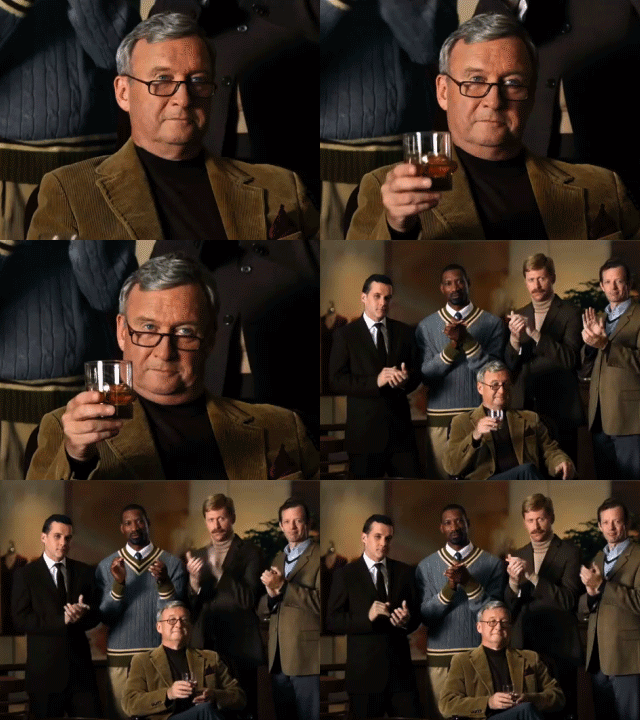
Sinclair (St Clair) family. take a bow.
|
|

 Home
Home RooshV.com
 Search (Via Forum)
 Member List



![[-]](images/collapse.gif) The following 1 user Likes kdolo's post:
The following 1 user Likes kdolo's post: